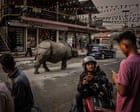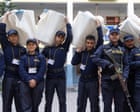





भोटेकोशी बाढीका मृतक पहिचान गर्न डीएनए परीक्षण प्रक्रिया सुरु
भदौ १० गते (अगस्ट २६) आएको विनाशकारी भोटेकोशी बाढीमा परी ज्यान गुमाएका र बेपत्ता भएकाहरूको पहिचानका लागि नेपाल प्रहरीले डीएनए परीक्षण प्रक्र…
Publisher
Guardian's Nepal topic feed — aggregates all Guardian coverage tagged Nepal (features, environment, politics, obituaries). Low volume but high-quality international framing. Feed is valid RSS 2.0 with full item bodies and no paywall gating.
Stories The Guardian covered alongside other publishers
भदौ १० गते (अगस्ट २६) आएको विनाशकारी भोटेकोशी बाढीमा परी ज्यान गुमाएका र बेपत्ता भएकाहरूको पहिचानका लागि नेपाल प्रहरीले डीएनए परीक्षण प्रक्र…
नेपाल र चीनको सीमा क्षेत्रमा हिमताल फुट्दा आएको विनाशकारी बाढी र पहिरोमा परी मृत्यु हुनेको संख्या १,००० नाघेको छ। प्रधानमन्त्री बालेन्द्र शा…
नेपालमा आएको विनाशकारी बाढीका कारण जलविद्युत आयोजनाको सुरुङभित्र फसेका दुई मजदुरलाई नौ दिनपछि जीवितै उद्धार गरिएको छ। नेपाली सेनाले हिलोले प…
नेपालमा आएको विनाशकारी बाढीपछि नुवाकोटको देवीघाट गाउँमा भएको व्यापक क्षतिको ड्रोन फुटेज सार्वजनिक भएको छ। भिडियोमा बाढीले क्षतिग्रस्त घर, पस…
नेपालमा आएको विनाशकारी आकस्मिक बाढीबाट प्रधानाध्यापक राजेन्द्र दवाडीले ९०० विद्यार्थीहरूलाई सुरक्षित स्थानमा सारेर बचाएका छन्। माथिल्लो तटीय…
नेपालमा आएको विनाशकारी बाढीमा परी बेपत्ता हुने अष्ट्रेलियाली नागरिकहरूको संख्या शनिबार बिहानसम्म ४१ पुगेको छ। विदेशमन्त्री पेनी वोङले अष्ट्र…
20+ headlines ingested

Facebook groups are checking information from family and friends of the missing against Nepal’s police database in a task where success is bittersweet at best Get our breaking news email, free app or daily news podcast A chain of flowers tattooed from knee to foot, a gold nose ring worn on a left nostril, a primary school tie caked in mud: these are the images that linger in Sonia Patil’s mind as she tries to help Nepali flood victims find their loved ones. More than 1,300 have died and at least 5,500 have been reported missing since a glacial collapse sent a torrent of water, mud, ice and debris through riverside communities along the Nepal-Tibet border on 26 August. Continue reading...

Foreign minister Shisir Khanal tells the Guardian the world’s biggest economies need to help Nepal, which contributes less than 0.1% of global greenhouse gas emissions Nepal is demanding $20m in climate compensation for the recent devastating floods, as a senior minister called on the world’s most polluting countries to “wake up” and accept shared responsibility for a disaster that led to the death or disappearance of more than 6,000 people. Scientists believe the climate crisis had a role to play in the floods, which were triggered when a melting glacier partially collapsed and set off a deadly landslide and flash flooding through Chinese-controlled Tibet and Nepal in late August. So far, more than 1,300 are confirmed dead and more than 5,500 still missing, with hopes of their survival diminished after 12 days of rescue operations. Continue reading...

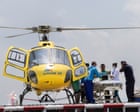
Chinese man at Trishuli hydropower project and Nepali woman in Nuwakot found 10 days into rescue operation Emergency responders rescued a Chinese man and a Nepali woman in two separate operations on Saturday, as authorities continued to search for thousands of people missing 10 days after massive floods hit Nepal. The Nepali military said a joint team comprising personnel from its army and South Korean disaster experts rescued the man from a tunnel in the Upper Trishuli-1 hydropower project, and that he was undergoing a health assessment. Pictures showed him being evacuated by helicopter after being carried out of the tunnel. Continue reading...

Arnold Dix, an Australian engineer and geologist who worked at Ground Zero after 9/11, says finding two workers alive in Trishuli 3A ‘gives us hope’ There is renewed hope amid the devastation wreaked by the flash flooding disaster on the Nepal-Tibet border as the world witnesses “one of the great rescues of the 21st century”. Nine days after the deadly floods, two workers were pulled out alive from a flooded hydropower tunnel in Nepal. Continue reading...

In this week’s newsletter: The full scale of the disaster is still emerging, but as rescue efforts continue, scientists warn that a warming Himalayas could mean more deadly hazards • Don’t get Down to Earth delivered to your inbox? Sign up here At 8.37am local time last Wednesday, a huge mass of rock and ice sheared free from a mountain, sliding 1,200 metres to the valley floor in Nepal’s Langtang national park, about 60km north of the country’s capital, Kathmandu. Horrifying images and videos soon emerged of a torrent of mud, water and debris that swept down the Lhende Khola valley at speeds approaching 150km/h. Flowing down the Lhende Khola, Bhotekoshi and Trishuli rivers that run between Tibet and Nepal, the flood water swept away homes, roads, bridges and power plants. Along the Trishuli, water levels rose by as much as nine metres in half an hour. As of the time of writing, the death toll of the disaster approached 1,000 people, with more than 4,400 on both sides of the border missing. Continue reading...

Vision from the Nepali army shows Sanjay Shah covered in mud and being carried from the site on a rescuer’s shoulder. He was one of two people who have been pulled out alive from a hydropower tunnel in Nepal nine days after deadly flash floods left them trapped Nepal-Tibet flash flood: Two workers pulled alive from hydropower tunnel nine days after disaster Continue reading...

Officials say pair were rescued from Trishuli 3A hydropower tunnel in Nepal after being trapped in depth of 170 metres Two people have been pulled out alive from a hydropower tunnel in Nepal nine days after deadly flash floods buried the projects in deep mud and left them trapped. The workers were rescued during an ongoing operation at the Trishuli 3A tunnel, a hydropower project in one of the areas worst-affected by last week’s deadly Nepal floods, according to army spokesperson Brig Gen Raja Ram Basnet. Continue reading...

After last week’s devastating floods, the Guardian’s south Asia correspondent, Hannah Ellis-Petersen, tells Annie Kelly about her journey to some of Nepal’s worst-hit areas, and what she found there More than a week after a melting glacier crashed into the valley below, triggering devastating floods across Nepal, some of the worst-hit places remain almost entirely cut off. Reachable only by treacherous, single-lane mud tracks, areas such as Betrawati and Rasuwa have lost whole communities – and authorities are still working to assess the true toll of the crisis. This week, the Guardian’s south Asia correspondent, Hannah Ellis-Petersen, along with photographer Ahmer Khan and journalist Gaurav Pokharel, made the journey to the frontline of the disaster to see the devastation first-hand, and to speak to the people whose lives, homes and loved ones have been lost in the floods. Continue reading...

There are 36 Australians among the thousands of people missing as rescue efforts continue after deadly flash floods on the Nepal-Tibet border Get our breaking news email, free app or daily news podcast The number of Australians missing in the Nepal-Tibet flash flooding disaster has fallen to 36, after two further people were confirmed safe on Friday. It comes after five previously unaccounted for Australians were confirmed safe earlier this week, with one found in Nepal, one in Tibet and three outside the crisis-hit area. A Sydney woman, Cara Severino, 25, was also safely located in Nepal more than two days after the 26 August floods. Continue reading...

Prof Lyla Mehta says the glacial floods and loss of life are a stark reminder that climate disruption is global and highly unequal. Plus letters from Lynda McDonald and Jan Bengtsson The recent glacial collapse and catastrophic floods in Nepal and Tibet are not isolated tragedies (Report, 28 August). They reflect accelerating climate disruption that disproportionately affects the countries and people that are least responsible for global emissions. As climate change intensifies, glaciers around the world, including in the Himalayas, are melting at unprecedented rates, destabilising ecosystems and causing glacial collapse and ice-and-rock landslides, destroying settlements, villages and livelihoods in minutes. No one died when a Swiss glacier collapsed last year, owing to early-warning systems that were in place. But a lack of early-warning systems means that the disaster in Nepal and Tibet has led to hundreds of deaths and thousands missing. Continue reading...

Visual storytelling is helping dismantle patriarchal norms that perpetuate child marriage in Bangladesh, India and Nepal, writes Ravi Baral Regarding your editorial (The Guardian view on child marriage: girls should not be wives, 26 August), every year, 12 million girls are married under the age of 18, while more than 70 million more are estimated to be at risk of child marriage between 2025 and 2030. Yet, as international development budgets face unprecedented contractions, traditional field programming alone cannot keep pace. At current funding levels, international funding for ending child marriage amounts to less than $1 per girl at risk per year – a level of investment that cannot match the scale or urgency of the problem Continue reading...

As Santosh Swaminathan and Nathan Subramanian wait for the army to restore access into the areas where their loved ones had been, they are growing increasingly desperate Australians missing in the Nepal floods: what we know so far Get our breaking news email, free app or daily news podcast As the hot sun beats down in Kathmandu, Santosh Swaminathan and his cousin Nathan Subramanian take a break from searching for their missing loved ones to stop at a temple and pray. After they lost contact with Swaminathan’s sister and her husband following the devastating flood last week, they flew from India to Nepal. But as they wait for the army to rebuild roads and bridges into the areas where their loved ones were, they’re getting desperate. Continue reading...

Guardian Australia’s Cait Kelly reports on the growing humanitarian crisis after the flood disaster in Nepal, where Kathmandu’s morgues are filling with bodies and families are desperately searching for missing loved ones. As more casualties arrive, authorities have been forced to establish temporary burial sites on the outskirts of the cities. At a teaching hospital, a wall plastered with missing-person notices is now completely covered, as families wait in hope that DNA testing will help to identify the bodies of loved ones ‘How do I not crumble?’ Loved ones of Australians missing in Nepal-Tibet floods fear others are turning away As Nepal’s morgues fill, Parkrit hopes her DNA can be used to find her mother Australians missing in the Nepal floods: what we know so far Continue reading...

About 46 people believed to be trapped in ‘room-like’ structure inside hydro plant tunnel on Nepal-Tibet border After the flood: human suffering on an unfathomable scale in Nepal’s worst-hit districts There is a high chance that dozens of workers may be found alive after a week trapped in an underground chamber at Nepal’s Rasuwagadhi hydropower plant after deadly flash floods, a Nepal electricity authority official has said. “In Rasuwagadhi, we think 46 people are trapped in a room-like structure in the tunnel,” Amhsu Kiran Shahi, a board member of the Nepal electricity authority, told Reuters on Wednesday. Continue reading...

Tragedy on the Nepal-Tibet border. Plus: How Mark Carney stood up to Trump • Get the Guardian Weekly delivered to your home address Over the last week, the world has watched with horror the scenes from the Tibet-Nepal border where a devastating torrent of mud, water and ice tore along the Bhotekoshi River, destroying entire communities and leaving more than 1,000 people dead and several thousand more missing. From the Nepali town of Devighat, our south Asia correspondent Hannah Ellis-Petersen describes a nightmarish scene of overflowing mortuaries and unidentifiable bodies, as shellshocked survivors of the flood slowly return to the ruins of their homes. Continue reading...

Thousands remain missing and aid is hampered by treacherous conditions in communities almost wiped out of existence Searching for the body of his wife in the mud, Dil Bahadur Shrestha lamented that he did not even have a shovel left. For now, he has been using his hands to try to find her as he picks through the ruins of his house. On Wednesday morning last week, Jamuna Shrestha, his wife of 50 years, had been at home in Betrawati on the banks of Nepal’s Trishuli River, feeding her beloved chickens and goats. Dil Bahadur Shrestha, who is searching for his wife of 50 years, Jamuna. Continue reading...

For now the psychology student and his 17-year-old brother are just trying to keep going as their parents would want Follow our Australia news live blog for latest updates Get our breaking news email, free app or daily news podcast Akash Venkatraman’s parents wished him a happy 22nd birthday before they left for Nepal on a spiritual pilgrimage. Three days later, a glacial collapse sent a torrent of mud, water and debris through the Nepal-Tibet border, bursting the banks of the Trishuli River, and sweeping away homes, bridges and roads. Continue reading...

Sum of $500,000 has been increased as death toll passes 1,000 but specialists decry Trump dismantling of USAID Aid experts have denounced the US’s “embarrassing” and “pitiful” initial response to the Nepal flood disaster after the US state department announced it was releasing $500,000 in emergency funds to help the relief effort. The modest sum – which has since been increased – allocated in response to the devastation caused by mudslides in the mountainous Asian country was mocked on social media, where users contrasted it with the amount spent on other Trump administration priorities. Continue reading...

At the Nepal Police hospital in Kathmandu, grieving families are lining up to provide DNA samples in the hope of identifying victims of the devastating floods. Guardian Australia reporter Cait Kelly, on the ground in Nepal, has documented the harrowing accounts of those searching for missing loved ones, including survivors who lost their parents Prakrit has already lost her father. As Nepal’s morgues fill, she hopes her DNA can be used to find her mother Australians missing in the Nepal floods: what we know so far One week on in Nepal – Full Story podcast Continue reading...

A week on from the flash flooding disaster, authorities are urging relatives of the thousands of missing and dead to provide blood samples An army official calls out a name. A young woman stands, two pieces of identification in her hands. She fills out a form, takes another and moves to the back of the hospital to give a vial of blood. With so many people killed by Nepal’s floods, and hundreds of bodies being buried because the morgues are full, there is now a push to identify victims through DNA. The woman, Prakrit Gurung, 19, is hoping her DNA will be linked to her mother’s body. Her father’s has been found – her brother recognised his picture on a wall outside the hospital. Continue reading...